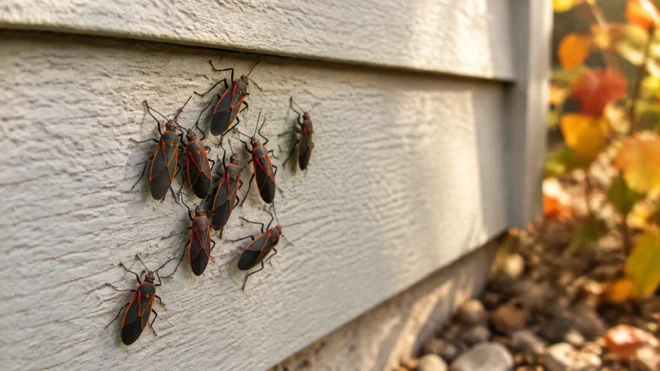
Boxelder bugs swarm Denver homes in fall because adult bugs leave host trees and gather on sunny, sheltered surfaces as temperatures cool. They are looking for protected places to overwinter, not food. They are mostly a nuisance, not a structural pest. Vacuuming, sealing entry points, and clearing debris near the foundation are the practical steps.
Few things are more frustrating than finding a cluster of insects around your windows just as you’re buttoning up your home for colder weather. If boxelder bugs are gathering on your Denver house, you’re not alone, and the good news is that they’re usually a nuisance, not a threat to your home.
By A.P. Pest Control | October 2026
Why Are Boxelder Bugs Swarming Denver Homes This Fall?
Boxelder bugs swarm Denver homes in fall because adult bugs leave host trees and gather on sunny, sheltered surfaces as temperatures cool. They’re looking for protected places to overwinter, not food inside your house. The Front Range’s warm, sunny autumn afternoons can bring them out in large numbers, especially near boxelder and maple trees.
Boxelder bugs are black insects with distinctive red-orange markings. They feed mainly on seeds from female boxelder trees and sometimes on maple seeds. When the season shifts, they move toward sheltered spots where they can wait out winter.
That can mean a south- or west-facing wall, a foundation, or a gap around your windows. In older, tree-lined areas such as Park Hill, Capitol Hill, Lakewood, and Arvada, nearby host trees can make fall gatherings especially noticeable.

Are Boxelder Bugs Dangerous to People or Your Home?
Boxelder bugs are generally considered nuisance pests: they don’t usually damage your home, reproduce indoors during winter, or pose a serious threat to people. Still, a large cluster can be unpleasant to look at, and crushed bugs may leave stains or an unpleasant odor on curtains, walls, and other light-colored surfaces.
The Colorado State University Extension guide to boxelder bugs explains that the insects overwinter as adults in protected places such as buildings and wall crevices. They may become active again on warm days, which is why you can spot them indoors even after cold weather begins.
A few helpful points to keep in mind:
- Boxelder bugs are mostly a nuisance, not a structural pest.
- They don’t typically reproduce inside your home during winter.
- They can leave marks or odor if crushed.
- You may see them indoors when a sunny day warms their hiding place.
The problem is solvable, but it helps to know how they gather and where they’re getting in.
Why Do Boxelder Bugs Gather on South- and West-Facing Walls?
Boxelder bugs often gather on south- and west-facing walls because these surfaces receive more afternoon sun and can stay warmer than shaded areas. Once gathered there, the insects may crawl into small openings around siding, windows, doors, foundations, and utility lines to shelter from the cold.
A tiny exterior gap can be enough to give them access to a wall void or other protected space. Check the sunny sides of your home first, especially around:
- Window and door frames
- Gaps between siding and the foundation
- Utility pipes and cables entering the house
- Damaged screens, vents, and weatherstripping
- Cracks or openings around trim

Walk around your home in daylight and look for both clusters and possible entry points. Sealing those gaps before more bugs move in is often more helpful than treating only the insects you can see.
What Should You Do About Boxelder Bugs in Denver Right Now?
For boxelder bugs you find indoors, vacuuming is usually the simplest way to remove them without crushing them. Outdoors, you can brush or rinse small clusters from a wall. Then focus on sealing entry points and reducing hiding places near the home so fewer bugs can get inside.
Try these steps:
- Vacuum indoor bugs. Empty the vacuum promptly, preferably outdoors, so the insects don’t crawl back out.
- Avoid crushing them. Crushing can cause staining and odor. There’s no good reason to assume that crushed bugs attract more bugs, but leaving them undisturbed on light surfaces can still make a mess.
- Seal easy entry points. Repair screens and weatherstripping, and caulk small gaps around windows, doors, siding, and utility openings.
- Tidy up the foundation edge. Clear leaf piles, weeds, and other debris where bugs can shelter.
- Check the nearby trees. Boxelder and some maple trees can be hosts, so note where the biggest clusters appear.
Detergent-and-water sprays can kill bugs they directly contact, but they won’t stop new bugs from gathering. They may also harm plants, so take care around vegetation. The CSU Agricultural Biology boxelder bug resource offers more information about their habits and control.
Why Can DIY Perimeter Sprays Fall Short, and What Does Professional Treatment Do?
A perimeter spray may kill some boxelder bugs it reaches, but it often won’t prevent new ones from gathering or entering through untreated gaps. CSU notes that many exterior insecticides are not especially effective for this pest. A professional inspection can help determine whether targeted treatment makes sense, or whether sealing and removal are the better next steps.

If you contact a pest professional, ask what they find and what they recommend before treatment begins. An inspection can help identify the main congregation areas and likely entry points. When treatment is appropriate, a professional can explain whether a product labeled for exterior use is suitable for specific resting or hiding places, and what precautions to follow.
A useful plan may include:
- Identifying where bugs are gathering and how they may be entering
- Discussing practical sealing and maintenance steps
- Considering a targeted exterior treatment if it’s warranted
- Reviewing product-label directions and any safety precautions
A broad spray isn’t automatically the right answer, and treatment won’t replace exclusion. At A.P. Pest Control, we believe in honest recommendations and no upselling, just a clear explanation of what may help your particular home. Learn more about our Denver pest control services or other pest control services.
How Can You Prevent Another Boxelder Bug Invasion?
The most practical prevention steps are to block access, repair openings, and reduce sheltered areas close to your home. The first hard freeze can reduce outdoor activity, but it doesn’t necessarily remove bugs already tucked into protected spaces. Warm, sunny days can bring those adults back into view.
Before the next warm spell, take a few minutes to:
- Caulk small gaps around windows, doors, siding, and utility penetrations.
- Repair torn window screens and worn door seals.
- Remove leaves and debris beside the foundation.
- Note which walls get the most sun and inspect them regularly.
- Ask an arborist for help identifying nearby host trees before considering removal.
Removing a female boxelder tree can reduce a nearby source, but it’s not always practical and doesn’t guarantee that bugs won’t arrive from other trees. CSU describes tree removal as a more permanent option, but one that may not be desirable. For many homeowners, careful exclusion and seasonal monitoring are more manageable.
Frequently Asked Questions
Boxelder bugs are most noticeable in fall, but the timing and number you see can vary with the weather and nearby host trees. They’re usually a nuisance rather than a sign of structural damage. These quick answers cover the questions Denver homeowners often have when the bugs appear.
Will the first hard freeze get rid of boxelder bugs?
A hard freeze can reduce outdoor activity, but it won’t necessarily eliminate adults already sheltered in a home or wall space. They may become visible again when a sunny day warms their hiding place.
Do boxelder bugs reproduce inside the house?
They generally don’t reproduce indoors during winter. Adults use protected spaces to overwinter and may return outdoors when conditions warm.
Should I crush a boxelder bug?
It’s better to vacuum it up or remove it without crushing it. Crushed bugs can leave stains and an unpleasant odor, especially on light-colored surfaces.
Do boxelder bugs mean my home is infested?
Not necessarily. A cluster outside often means the bugs are gathering on a sunny wall near host trees. If you’re seeing them indoors repeatedly, inspect for gaps around windows, doors, siding, and utility lines.
Is professional treatment always necessary?
No. A few bugs may be manageable with vacuuming and sealing. If large numbers keep returning or you can’t find how they’re getting in, an inspection can help you choose practical next steps.
You can also explore our Denver pest control information.
Boxelder bugs can be persistent, but they’re a manageable fall nuisance. If you’d like help figuring out what’s happening around your home, call A.P. Pest Control at (720) 327-1750 or request a free quote online. We’re a family-owned Denver-area business that treats every customer like family, offers honest pricing, and backs our work with a 100% satisfaction guarantee.